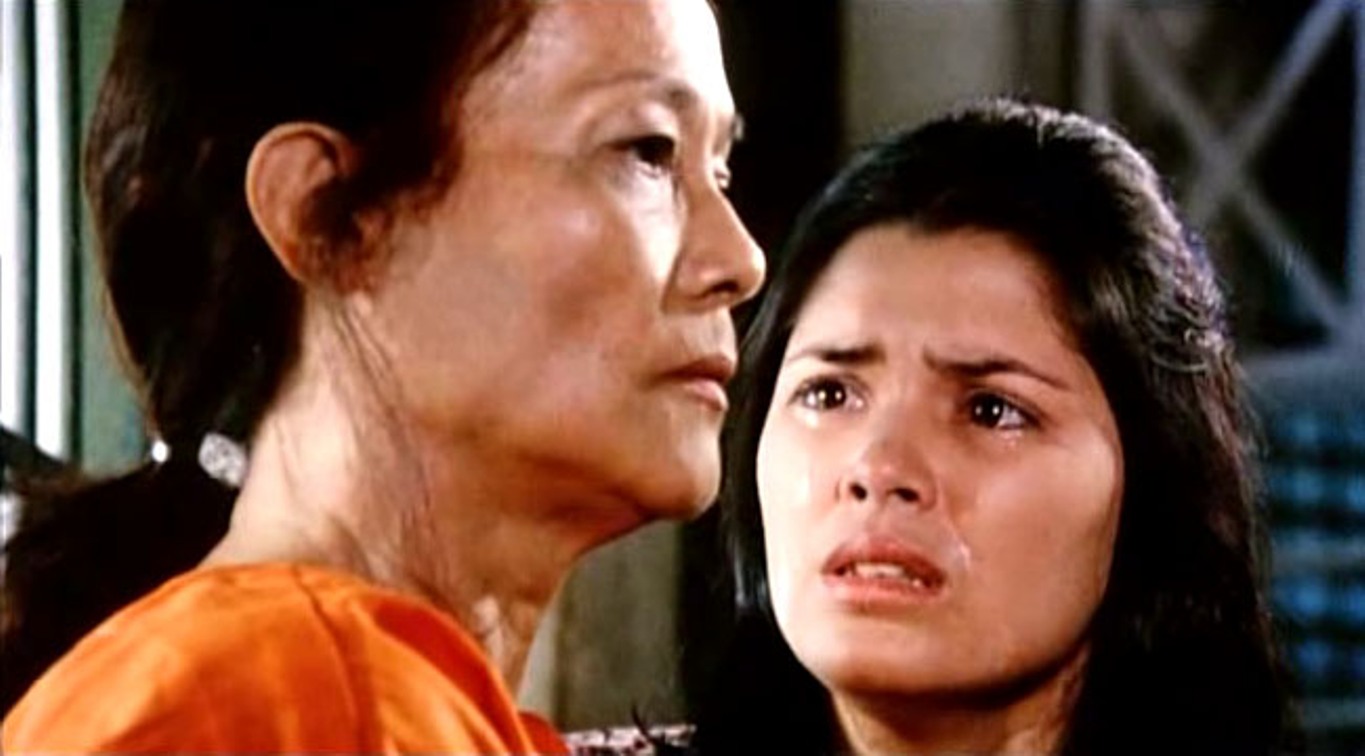
The film is directed by Lino Brocka, depicting the harrassment and exploitation of Insiang, a young girl living in Tondo. The film begins at a slow pace, introducing its main cast of characters. Insiang, who lives with her mother Tonya, and Dado, a butcher who moves into their residence as Tonya’s romantic partner. Initially Insiang and Tonya had been living with their relatives, though after an incident followed by a heated arguement, Tonya evicts them and from there on Dado enters the picture.
Tonya is shown to be a strict, borderline abusive woman. She developed her toxic personailty after her ex-husband had found another, leading her to be more controlling of her daughter and prohibitting her from seeing men. Insiang, however, is already seeing Bebot. One night, Bebot sneaks into Insiang’s room, however the two are seen by Dado who tells Tonya of what happened the following day. Later on in the film, Dado knocks out Insiang and takes advantage of her body. Of course, Tonya doesn’t believe Insiang when she tells her about what happened, even calling her daughter a liar and punishing her further.
Bebot seems to be the only solace for Insiang at this point, although it is revealed that Bebot only wanted to have sex with her, leaving without her notice. Insiang returns home to Tonya and Dado, and then she cooks up a plan to take revenge on the people that exploited her, using Dado as her instrument for putting everything into action. Insiang convinces Dado into starting a romantic relationship, allowing him to sneak over to her bedside at night. She manages to use Dado to attack her ex-boyfriend, Bebot and knots him deeper into a web of deception. Unaware of Insiang’s plans, Tonya becomes jealous of her relationship with Dado and confronts Insiang. The two get into an arguement with the odds being against Tonya when the proof is presented to her. In a rage, Tonya stabs Dado in the back essentially completing Insiang’s retribution plot.
Lino Brocka, like many other film directors during Martial Law, integrates a handful of political metaphors in his projects. Insiang’s character relationships and plot developments tells a story that goes beyond what is presented to us. At face-value the film is one that idealizes Insiang’s quest for retribution, delving deeper into the film’s symbolism we begin to understand the context of the story even more. The opening scene shows pigs being slaughtered, which is Dado’s occupation and place of work. Ironically by the end of the film, he himself gets butched by Tonya for lying and taking advantage of her and Insiang. Dado is depicted as a pig in the story, showing no shame in his actions and unable to control himself. The men in the film represent the overpowering dimension of society, taking advantage of those unable to defend themselves and using others for their own gain. Insiang was merely a victim of circumstances, having to live under the roof of an emotionally wounded mother who lost her sense of reason. At the end of the film Insiang visits her mother in prison where they seemingly reconcile, explaining that she really does love her mother. Tonya, looks back at Insiang walking away, regretting how she neglected her daughter when she was put through all the abuse.
Insiang is a film that shows no fear in getting its message across. Reflecting the country’s history during its time in Martial Law, Insiang can be viewed as the revolutionary movement while Tonya and Dado canbe seen as the domineering forces that ruled over the country during Martial Law. The parallels between the film and Philippine history can be vaguely seen, where Insiang wants to simply live free from exploitation and living as her own person. Insiang can also be viewed as a form of representing the strengths of women as they are also people who deserve to stand equally with everyone else. The film has so much context in society drawn from the symbolisms located all throughout its runtime. Insiang is able to deliver an impactful retribution story and more importantly acts as a medium of vocalizing societal ills.
 FILMLANG-DeLeon Film Review